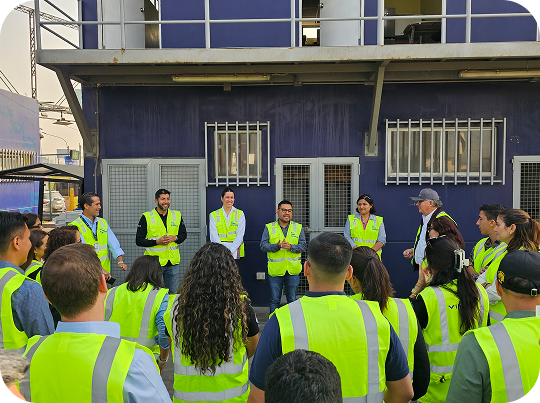
In Peru, IFRS S1 and S2 will take effect in 2029 for companies subject to the regulations. Preparing for this involves much more than just preparing a report: it requires identifying gaps, organizing information, and linking sustainability and climate risks and opportunities to their potential financial impacts. Starting today allows you to build these processes incrementally and avoid having to do so under pressure.

We build the capacity of boards and key teams to understand regulations and connect them to business risks and decisions.

We assess your company's level of readiness in the areas of governance, strategy, risk management, and metrics and goals.

We defined the actions, milestones, and responsible parties needed to move forward in an orderly manner toward the first report.

We identify how your carbon footprint, reports, and current processes can contribute to compliance with IFRS S1 and S2.






IFRS S1 and S2
Training for senior management and sustainability committees.
Industry Experience
More than 14 industries with customized solutions.
TCFD
We bring the board and key teams up to speed on what the standards require, why they are relevant today, and what they mean for the organization. We assess the group’s starting point at the beginning of the session.
We identify what information exists, where it is located, and who manages it, in relation to the four pillars of the standard.
We delivered a prioritized plan that defines the scope of reporting, data collection processes, data governance, the identification of climate-related risks and opportunities, and the necessary internal controls, with quarterly milestones and designated leads for each area.
We start with the team’s current level of knowledge and tailor the content to the industry and its challenges. We use case studies and real-world business scenarios to connect IFRS S1 and S2 to decision-making.
IFRS S1 and S2: What Your Company Needs to Start Preparing for Today
These are standards issued by the International Sustainability Standards Board (ISSB) of the IFRS Foundation, the same institution that issues the IFRS accounting standards. IFRS S1 establishes the general requirements for disclosing information on sustainability-related risks and opportunities; IFRS S2 sets out the specific requirements regarding climate and is always applied in conjunction with S1. Both are structured around four pillars, derived from the TCFD: governance, strategy, risk management, and metrics and targets.
Yes. The Accounting Standards Board adopted them through Resolution No. 001-2026-EF/30. They will be mandatory as of January 1, 2029, for companies not supervised by the SMV or the SBS with annual revenues equal to or greater than 2,300 UIT. For supervised companies, the SMV and the SBS will establish their own provisions and deadlines.
Companies that exceed the 2,300 UIT threshold, companies supervised by the SMV and the SBS—which will follow their own timeline—and subsidiaries of groups whose parent companies already report under similar standards. This also applies to companies in their value chains and those seeking financing.
These are two complementary perspectives. The GRI addresses the company’s impact on people and the planet. IFRS S1 and S2 address the sustainability risks and opportunities that may affect the company’s cash flows, access to financing, and cost of capital, and are aimed at investors.
IFRS S2 requires the disclosure of Scope 1, 2, and 3 greenhouse gas emissions, measured in accordance with the GHG Protocol. Companies that already measure their carbon footprint have a solid foundation for complying with the standard.
This session is tailored to the organization, its industry, and its audience. It can be aimed at boards of directors and sustainability committees to align their vision and preparedness decisions, or at operations, risk, and finance teams to help them recognize how sustainability issues connect to the business. It is a good first step for companies that have not yet begun their preparedness efforts.
It depends on each company’s starting point. The gap analysis and roadmap can be developed in a few weeks; implementation by the company typically takes one to two years. Therefore, it is recommended that 2026 be the year for conducting the gap analysis.
The assessment requires information on the governance structure, risk management processes, existing sustainability reports, and—if available—carbon footprint measurements. The question is not whether we’re starting from scratch, but what already exists and how it all fits together.
We support organizations during the preparation phase: awareness-raising workshops, gap analysis, and the development of a roadmap that the internal team can follow to produce the first report. We combine technical rigor with a strategic vision so that compliance generates value for the business.
Let's discuss where your company stands with regard to IFRS S1 and S2, and together we'll design a workshop or a customized preparation plan tailored to your needs.
We use cookies own and of third parties to improve your browsing experience, analyze site traffic, and personalize content. You can accept all, reject, or set your preferences.


