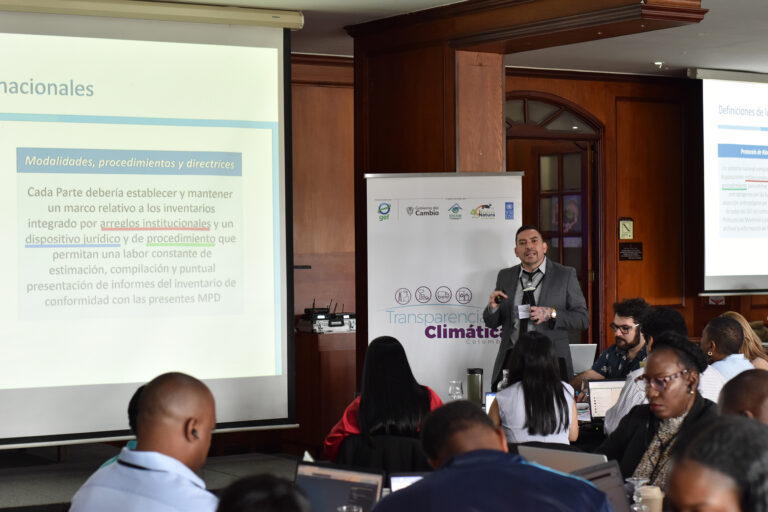
From July 23 to 25, Colombia, the Training for the development and submission of national inventory reports (NIR) under the enhanced transparency framework (ETF) of the Paris Agreement., an effort of The Partnership for Transparency in the Paris Agreement (PATPA, for its acronym in The Transparency Capacity Building Initiative - The Global Support Program (CBIT-GSP), the Institute of Hydrology, Meteorology and Environmental Studies (Ideam) y the Government of Colombia.
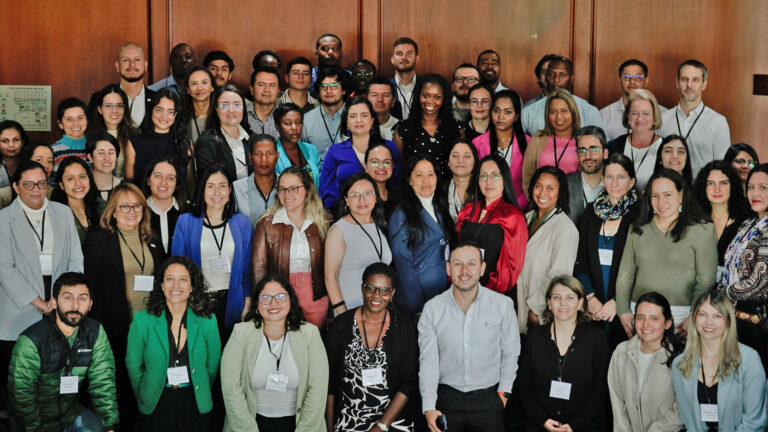
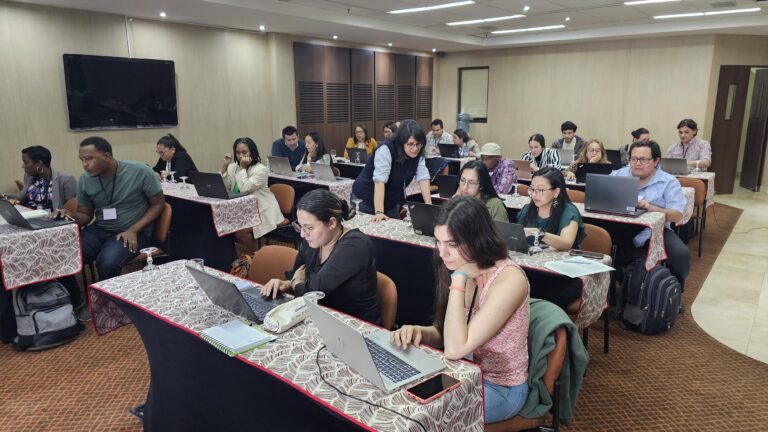
For three days, public officials from 29 countries in Latin America and the Caribbean (with 58% of female representation) received training and participated in dialogues to analyze, review and learn how to submit their Greenhouse Gas Inventory Reports (NIR), which are key to the Transparency Framework because they provide information on countries' progress towards the decarbonization of their economies.
Tim Bantel, PATPA's regional coordinator for LAC, said that transparency is key to the Paris Agreement because it allows countries to develop specific and ambitious targets and helps to track them. “Transparency allows for trust between countries and gives the possibility to create evidence-based policies.”he said.
Pia Zevallos, CEO of Libélula and facilitator of the workshop, together with a group of experts, explained that transparency is a transcendental issue in the context of climate change. "At the national level, it generates commitment from all actors in society with respect to climate objectives, and allows the construction of a sustainable climate policy.”, he said.
You can also read: Five facts you need to know about the Paris Agreement Transparency Partnership
Tools and new knowledge to strengthen transparency
The meeting also provided updated tools and information for countries to report their Biennial Transparency Reports (BTR). “In this workshop, country representatives obtained information on the new requirements, modalities, procedures and guidelines for transparency in the Paris Agreement. In addition, they analyzed the tools that countries can use to compile their Greenhouse Gas (GHG) inventories, as well as the reports of the United Nations Framework Convention on Climate Change (UNFCCC).”said Fatima-Zahra Taibi, CBIT-GSP global coordinator.
Chanel Hamilton, representative of the Bahamas, indicated that transparency is very important for her country, particularly in reporting BTRs and Nationally Determined Contributions (NDCs). She added that it is critical to be accurate and share that information so that the world knows how much the Bahamas is emitting as a small island state. “Transparency is also important when it comes to the funding we receive for mitigation and adaptation.”he emphasized.
Daysy Cárdenas, representative of Ecuador, emphasized that the country is working assiduously to strengthen its National Climate Change Registry, which is stipulated in the Organic Environmental Code, and is therefore developing actions hand in hand with international cooperation. “This workshop is very important for us because we are preparing the emissions inventories for 2020, 2021, 2022, the 5th National Communication and the first BTR; so the feedback we have received in Bogota is fundamental.” indicated.
Almendra Cáceres, Libélula's project manager, concluded and indicated that the meeting was key to strengthening technical capacities, exchanging experiences in the Latin American and Caribbean region, and with which participants will have more tools and information to develop their GHG inventories with the new enhanced transparency framework of the Paris Agreement.
It is important to remember that the presidency of the COP29 to be held in Baku, capital of Azerbaijan, has placed a very clear focus on the presentation of the BTRs. This is why the countries of Latin America and the Caribbean have a very important opportunity to provide transparent information on their biennial transparency reports and thus demonstrate their actions to address climate change.
Data:
Learn more about the Partnership for Transparency in the Paris Agreement here
You can also read: Three Keys to Transparency in the Paris Agreement



 hace 2 year