"The encyclical "Laudato Si" is the contribution of the Catholic Church to COP21."
 hace 11 year
- The Forum “Caring for the Common Home: Encyclical Laudato Si”, highlighted that the Vatican document seeks to establish harmony and reflection in the human lifestyle.
- The papal encyclical, which received contributions from more than 200 people around the world, proposes moving towards clean energy, ending fossil fuel subsidies, and transferring technology to developing countries.
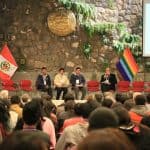
June 18 was a historic day for the inhabitants of the planet who are committed to caring for the environment. With great expectation, Pope Francis unveiled the the first great encyclical letter of his papacy, entitled “Laudato Si” (“Praised Be” in Latin), which focuses on ecology. To provide more details on this important document and in the framework of the second climatic week, the Ministry of Environment and the Ruiz de Montoya University held on Monday, August 24 at the Marriot Hotel, the forum: Care for the Common Home: Encyclical Laudato Si.
The meeting - which sought to strengthen reflection on the encyclical and environmental problems at the local and global levels - was attended by Dr. Ernesto Cavassa, rector of the Universidad Antonio Ruiz de Montoya; Mons. Eduardo Agosta, director of the Climate, Environment and Society Studies Team of the Faculty of Physicomathematical Sciences and Engineering of the Pontifica Universidad Católica Argentina; Dr. Carlos Amat y León of the Universidad del Pacífico; Lupe Guinand, manager of Libélula Special Projects; and Laura Vargas, executive secretary of the Interreligious Council of Peru.
Carlos Amat y León opened the event by explaining that the encyclical Laudato Si seeks to favor the alliance between the environment and human beings, and in turn achieve an integral, ecological and communitarian connection. “The Vatican's call is to establish harmony and reflection on our lifestyle,” he said.
The four main axes of the encyclical
The papal document that arrived a few months before governments meet at the UN conference on climate change in Paris (COP21), where they will sign a universal agreement to limit greenhouse gas emissions and prevent the increase in global average temperature from exceeding 2°C, presents for Monsignor Pedro Barreto four main axes that give it a strong social and evangelizing conscience.
- Intimate relationship between the poor and the fragility of the planet: “There is a very close relationship between climate change and the poor, and there is a very serious concern on the part of Pope Francis”.
- The world understood as a whole: “Everything created: people and nature are connected, wisely connected”.
- The critique of the new paradigm: “The new forms of power that will be initiated with technoscience or technology”.
Invitations from Pope Francis: “Pope Francis invites us to seek other ways of understanding ecology and politics. - It invites us to have sincere and honest debates about scientific truth and moral truth, to be aware of the responsibility of international and national politics, and to understand the proposal of a new sober and austere lifestyle”.
Monsignor Pedro Barreto indicated that the encyclical should not be considered as a theory, but as a foundation for action that should begin right now. “Laudato Si explains that peasants and indigenous people are not taken into account and suffer the consequences of bad extractive practices, causing a social culture with signs of violence, suffering and death. What is sought is to correct the growth models and also to denounce the aggression to the environment by some companies that carry out serious pollution in Latin American countries, because they cannot do it in their own countries. The encyclical proposes a reflection to recognize that the environment is full of wounds, produced by our irresponsible behavior, because when nature is mistreated, the person is mistreated and vice versa."he said.
The most affected areas
Eduardo Agosta explained that one of the effects of climate change is the rise in sea level and there are regions where this anomaly is felt more strongly. “The most affected area is the Central Pacific, so it is not surprising that the first to be alert to climate change are the populations of the South Pacific, including the Philippines; that is why the encyclical is a reflection on the part of the whole world, not only for believers.”.
The specialist indicated that the encyclical highlights the alternative of a revolution of new energies, and establishes that dialogue and education are the keys to overcome the scenario of destruction in which society finds itself. “The encyclical is very clear that there must be a shared but differentiated responsibility, because we should not all pay in the same way for the consequences of climate change”.
Contribution to COP21
Lupe Guinand explained that the encyclical Laudato Si presented by Pope Francis is the Catholic Church's contribution to COP21. “It is a contribution of the Pope to become aware of the problem we have in relation to climate change and to understand the possibility that in Paris there will be a strong and binding agreement to begin to solve the issue of climate change.".
The specialist highlighted three points in the document: a transition to renewable energies, ending fossil fuel subsidies, and the need for technology transfer to developing countries, because otherwise an agreement cannot be reached during COP21. “These are the basic points of the negotiation and they are effectively found in the encyclical”Guinand pointed out.

← Previous
Next →