


Circular economy as an engine of profitability and employment | Dragonfly

Do you prefer to listen? Plays the audio here
With 23,000 tons of waste daily, the challenge is not only environmental: but also economic.
Marian Buraschi - Partner and Director of Dragonfly
In the current scenario of volatility in the prices of raw materials, the waste management in Peru has ceased to be an operating cost to become a business unit strategic. The Ministry of the Environment (MINAM) specifies that in the country are generated 23,000 tonnes of solid waste per day, which raises the challenge of transforming a "mine urban" subexplotada in an engine of economic recovery. In accordance with the MINAM, 77% of this waste has the potential of recovery, but just recycle the 1.9%. This gap is not just an environmental problem; it is an inefficiency of the financial business sector must lead to the capture of value.
The value chain of the recycling is, by nature, are labor-intensive. While the final disposal in landfills is a linear process that produces low-value-added, recycling creates an ecosystem that today supports nearly 500,000 families in peru. The key to entrepreneurship lies in the formalization of the 180,000 recyclers base (MINAM). Data to 2025 show that, in districts where it has integrated the waste pickers in the logistics chain formal, the collection efficiency of reusable materials increased by 46%. In the last year alone, the sale of these residues generated revenue more of S/ 3.8 million in the formal sector, demonstrating that the professionalization reduces costs and ensures the inputs.
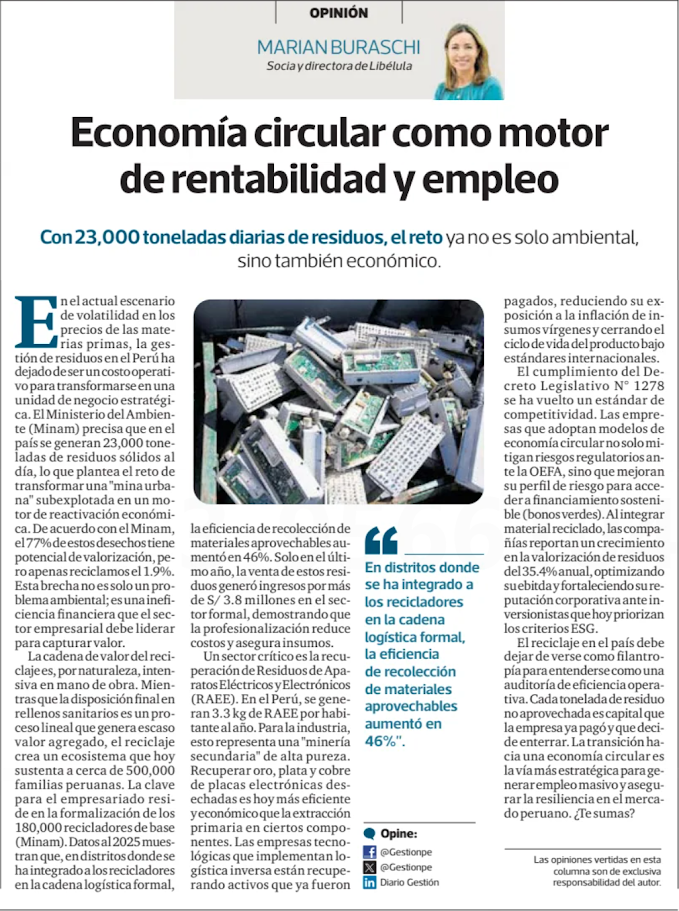
A critical sector is the recovery of Waste Electrical and Electronic Equipment (WEEE). In Peru, they are generated 3.3 kg of WEEE per inhabitant per year. For the industry, this represents a "secondary mining" of high purity. Recover gold, silver and copper plates electronic waste is now more efficient and more economic than primary extraction in certain components. The technology companies that implement reverse logistics are retrieving assets that were already paid for, by reducing their exposure to the inflation of inputs virgin and closing the life cycle of the product under international standards.
Compliance with the Legislative Decree N° 1278 it has become a standard of competitiveness. Companies that adopt models of circular economy does not only mitigate regulatory risks to the OEFA, but also improves its risk profile in order to access to financing sustainable (Green Bonds). To integrate recycled material, the companies reported growth in the recovery of waste of 35.4% annual, optimizing its EBITDA, and strengthen your corporate reputation with investors today prioritize the criteria ESG.
Recycling in Peru should not be as philanthropy to be understood as an audit of operational efficiency. Each ton of waste used is capital that the company has already paid and who chooses to bury. The transition towards a circular economy is the way more strategic to generate massive job and ensure resilience in the peruvian market. ¿Te sumas?
Published in Journal Management.

← Previous
Next →

Stay up to date
Receive a summary of relevant news about companies and sustainability. All the months. Free!
